AI Summary: Acura Collision Repair in Los Angeles – Key Insights
- Collision risk remains high in Los Angeles. Rear-end accidents are among the most common types of collisions, making professional Acura repair a frequent necessity for local drivers.
- Specialized structural repair is essential. Acura’s Advanced Compatibility Engineering™ (ACE™) body structure requires manufacturer-approved repair procedures to preserve crash protection.
- ADAS calibration is a critical repair step. Modern Acura vehicles equipped with AcuraWatch™ rely on accurate recalibration of cameras and sensors after many collision repairs to restore driver-assistance features.
- OEM parts help preserve long-term value. Genuine Acura components support proper fit, safety performance, warranty protection, and stronger resale value compared to many aftermarket alternatives.
- California drivers choose their repair facility. State law allows vehicle owners to select the collision repair shop they prefer, regardless of insurance company recommendations.
- Electric and hybrid Acura models require specialized expertise. High-voltage systems demand technicians trained to safely repair electrified vehicles using appropriate equipment and procedures.
- Repair costs depend on damage severity. Cosmetic repairs generally cost significantly less than structural repairs involving frame correction, OEM parts, and ADAS recalibration.
- Insurance supplements are common. Hidden damage often becomes visible only after teardown, making supplemental insurance approvals a normal part of the repair process.
- Detailed repair documentation adds value. Complete records of parts, procedures, and repairs help support future resale value and buyer confidence.
- Insurance claims can be managed for you. Metro Collision Center works directly with major insurance carriers throughout the repair process, helping streamline approvals and reduce administrative work for customers.
Beyond the Surface: Why a Specialized Acura Body Shop Is Crucial After an Accident
There is a particular kind of stress that follows a collision in a vehicle you’ve invested in — not just financially, but emotionally. Your Acura represents a deliberate choice: a machine engineered at the intersection of Honda’s manufacturing precision and genuine luxury ambition. The moment another vehicle clips your rear quarter panel or a distracted driver runs a light, that investment feels suddenly, viscerally fragile.
This stress is legitimate, and it deserves a legitimate response — not a generalist repair shop that handles everything from lifted trucks to economy sedans, but a dedicated Acura body shop that understands exactly what your vehicle is made of.
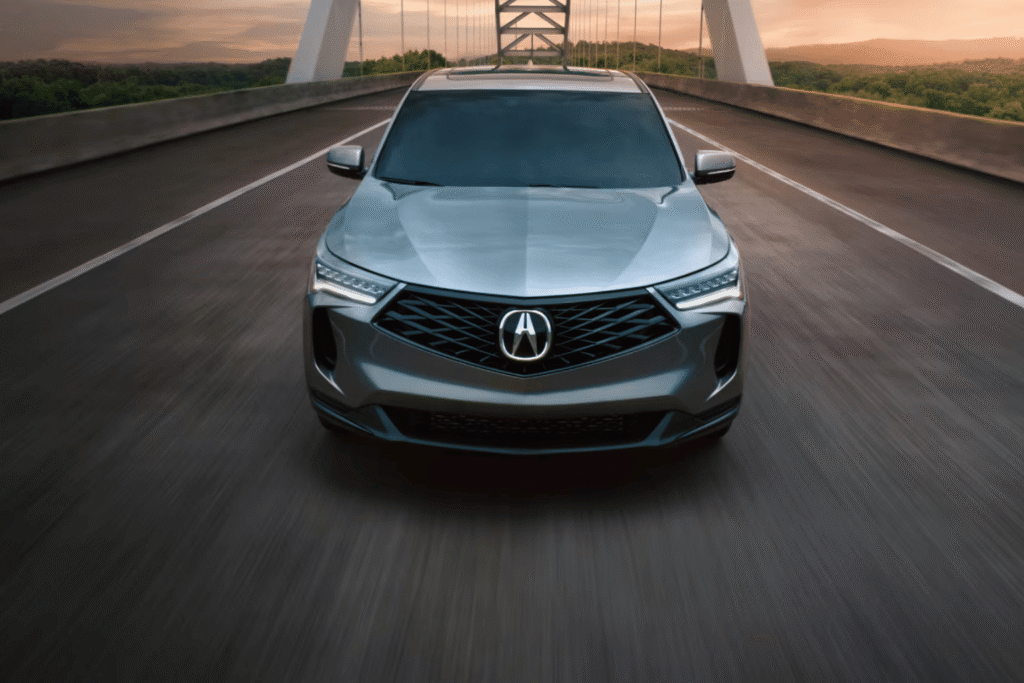
And in Los Angeles, the odds that you’ll need one are not trivial. The city recorded approximately 28,916 reported crashes in 2024 — an average of nearly 79 collisions every single day. Overall reported car crashes in Los Angeles County have remained relatively stable at around 41,000 annually. On the 405, Sunset Boulevard, and the surface streets of Silver Lake and the Westside, collision damage is not a remote possibility for LA drivers — it is a near-statistical certainty over any meaningful ownership period. Shakhnis LawAmendtlaw
Did You Know? Rear-end collisions made up 52% of all crashes in Los Angeles in 2024 — the most common collision type by a wide margin. Bumper-to-bumper freeway traffic and stop-and-go urban driving are the primary drivers of this pattern. Erlawyers
What most drivers do not realize is that those rear-end impacts — the ones that look like “just a bumper” — are precisely the collisions most likely to cause invisible, complex damage to a modern Acura.
Acura vehicles are built around Honda’s proprietary Next-Generation Advanced Compatibility Engineering™ (ACE™) Body Structure. The ACE body structure uses a network of interconnected structural elements — incorporating more than twice the high-strength steel of previous generations — to absorb and distribute crash energy away from the passenger compartment. Every gram of that structural steel is engineered to behave in a precise, predictable way during a collision, channeling energy over, under, and around the occupant cabin through designated crumple zones. Acura
When a non-specialist repairs these structures using generic methods, welding procedures, or incorrect replacement parts, they do not simply fix cosmetic damage. They compromise the physics the vehicle depends on to protect its occupants in any future crash.
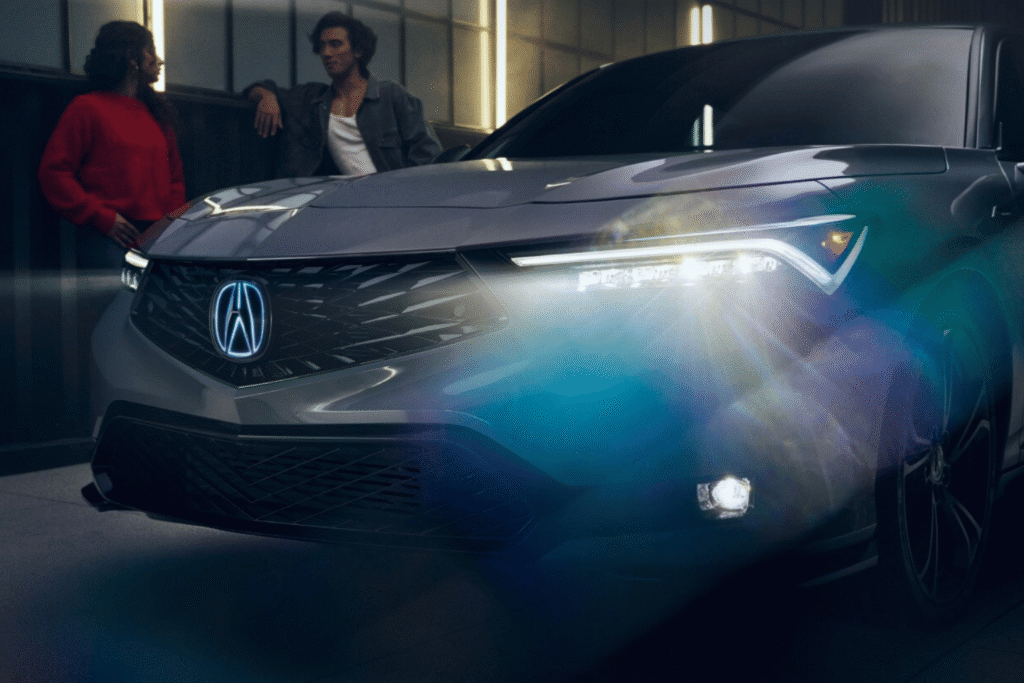
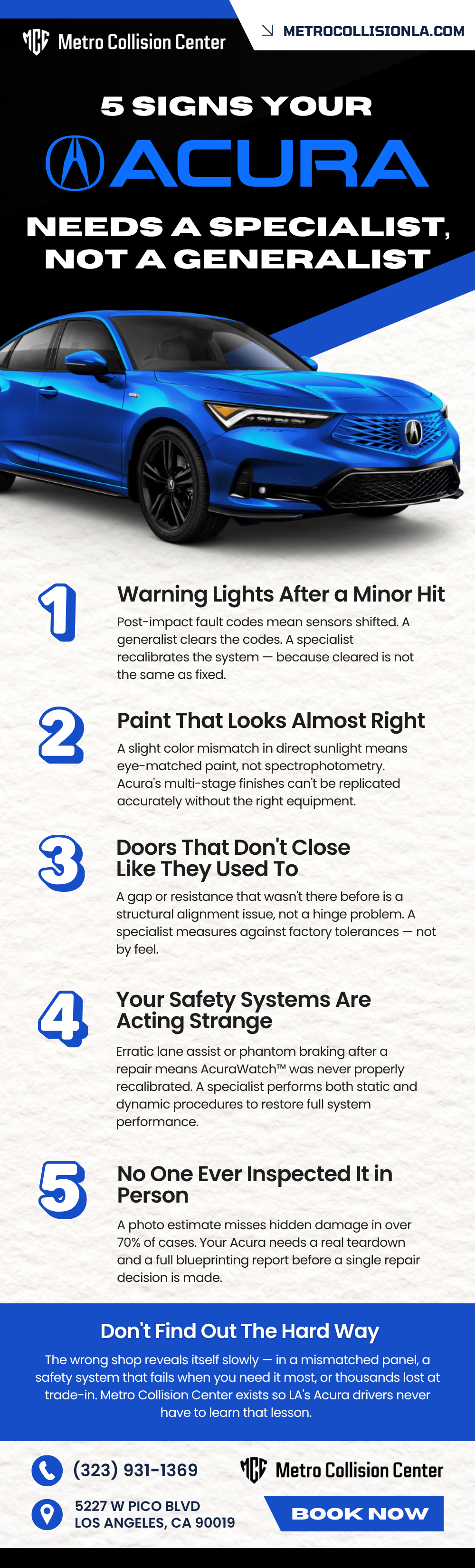
Beyond the structural argument, there is the matter of AcuraWatch™. This suite of driver-assistance technologies — forward collision warning, automatic emergency braking, lane-keeping assist, adaptive cruise control — relies on forward-facing cameras and millimeter-wave radar sensors that are physically mounted to body panels. Even a minor impact, one that leaves barely a scratch on the bumper cover, can shift those sensors by fractions of a millimeter. That shift is enough to produce dangerous miscalibrations in lane-departure warnings and emergency braking response.
Only a certified, specialized Acura body shop has the diagnostic equipment, factory technical data, and trained technicians to address all of these systems — not just the visible surface. Metro Collision Center is that shop for Los Angeles drivers.
The Metro Collision Advantage: Your Premier Destination for Acura Collision Repair in Los Angeles
Metro Collision Center was built on a single foundational belief: that premium vehicles deserve premium repair — not approximations, not workarounds, and certainly not cost-cutting shortcuts driven by insurer pressure.
When your Acura arrives at our facility for Acura collision repair in Los Angeles, the process begins before a single tool is picked up. Our technicians conduct a comprehensive, transparent blueprinting assessment — a meticulous pre-repair documentation process that identifies every impact-related concern, including those invisible to the naked eye.
Industry Fact Worth Knowing: Studies show that over 70% of photo-based insurance estimates require supplements once a shop conducts a detailed teardown, as hidden structural damage or sensor misalignment only becomes apparent during an in-person inspection. This is why our on-site blueprinting — not a photo estimate from an insurer’s app — is the foundation of every repair we perform.
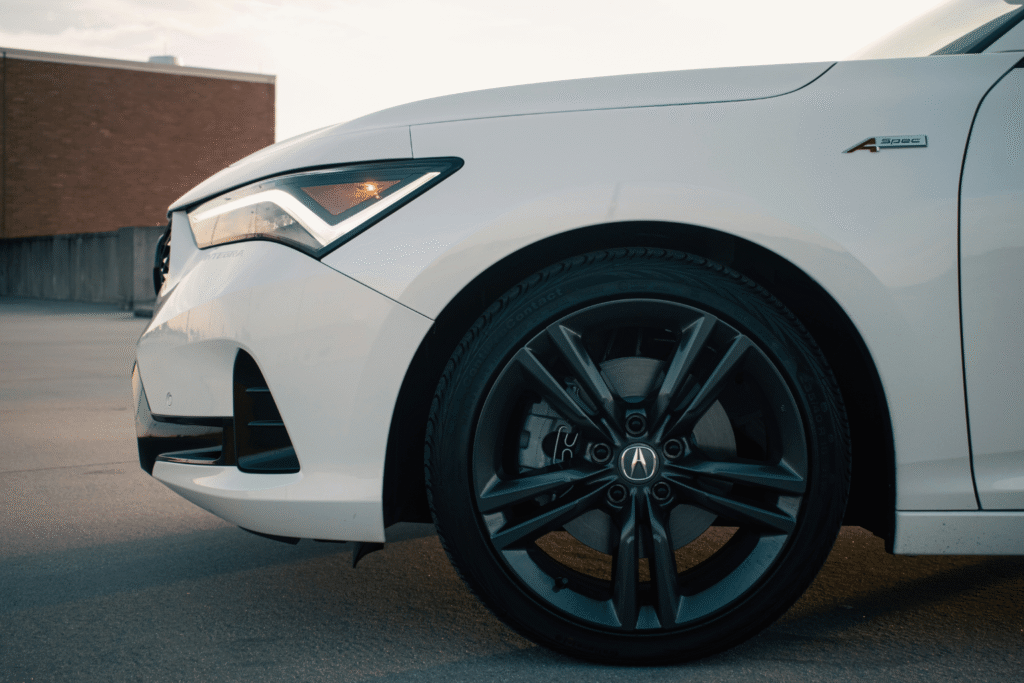
This blueprinting philosophy exists because collision damage is deceptive. A rear-end impact that cosmetically affects only the bumper cover can transfer force through the subframe mounts, subtly misaligning the rear axle geometry. Our structural measurement systems detect these deviations before they become permanent handling problems.
Our facility brings together:
- Factory-trained technicians with deep specialization in Japanese luxury vehicle platforms
- Computerized frame straightening and structural realignment systems calibrated to Acura's factory tolerances
- OEM-authorized parts sourcing to ensure every replaced component is a genuine Genuine Acura Part
- AcuraWatch™ recalibration capability using both static and dynamic procedures to restore all sensor systems to factory specification
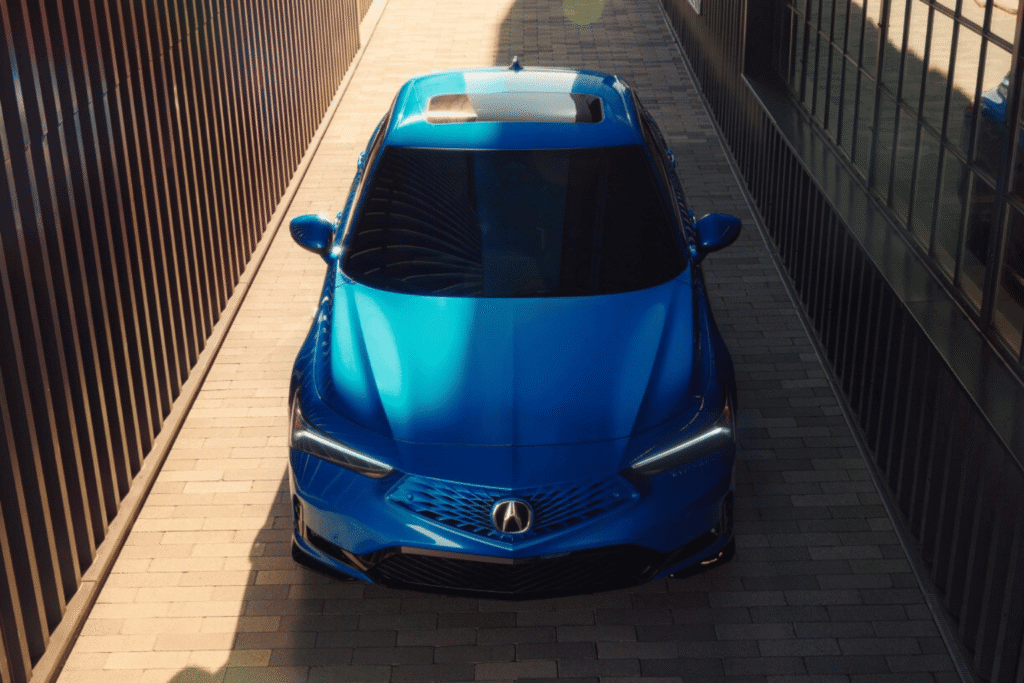
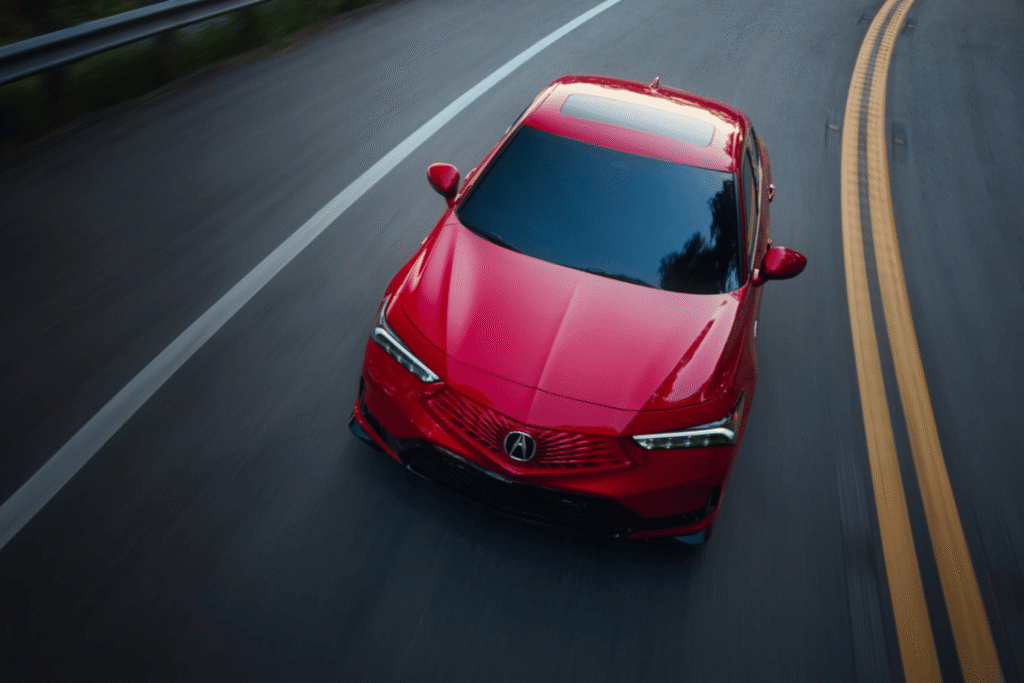
- Waterborne, computerized paint matching that replicates Acura's complex multi-stage factory finishes — including Apex Blue Pearl, Performance Red Pearl, and Majestic Black — without visible repair boundaries
- A dedicated insurance liaison team that communicates directly with your carrier, advocates for correct repair methodologies, and works to eliminate surprise out-of-pocket costs
When we return your vehicle, it does not leave until it performs and appears exactly as Acura intended. That commitment is backed by a lifetime craftsmanship guarantee on all repairs performed at our facility.
For Acura drivers across Los Angeles — from Silver Lake to the South Bay, from the Valley to the Westside — Metro Collision Center is the Acura collision repair Los Angeles destination that treats your vehicle as a precision instrument, not a line item.
2026 Collision Repair Evolution: How Acura Safety Systems Demand Next-Gen Technology
The collision repair industry in 2026 looks profoundly different from even five years ago — and nowhere is that transformation more pronounced than in the service of advanced luxury vehicles like Acura.
The ADAS Calibration Surge Is Now Unavoidable
In 2017, only 0.9% of repairable appraisals included a calibration. By 2025, that share had surged to more than 23%, with the growth rate accelerating year over year. That trajectory has a clear destination. Collision repairers who specialize in select luxury makes may see 90% or more of their claims requiring calibration as early as 2025. CCC Intelligent SolutionsCaliber
Striking Stat: A Revv benchmark study found that roughly 61% of vehicles arriving for collision repair require some form of ADAS calibration — yet nearly half of all U.S. shops miss required post-repair calibrations entirely. That gap is a genuine safety crisis for drivers who believe their vehicle was fully restored. Autobody News
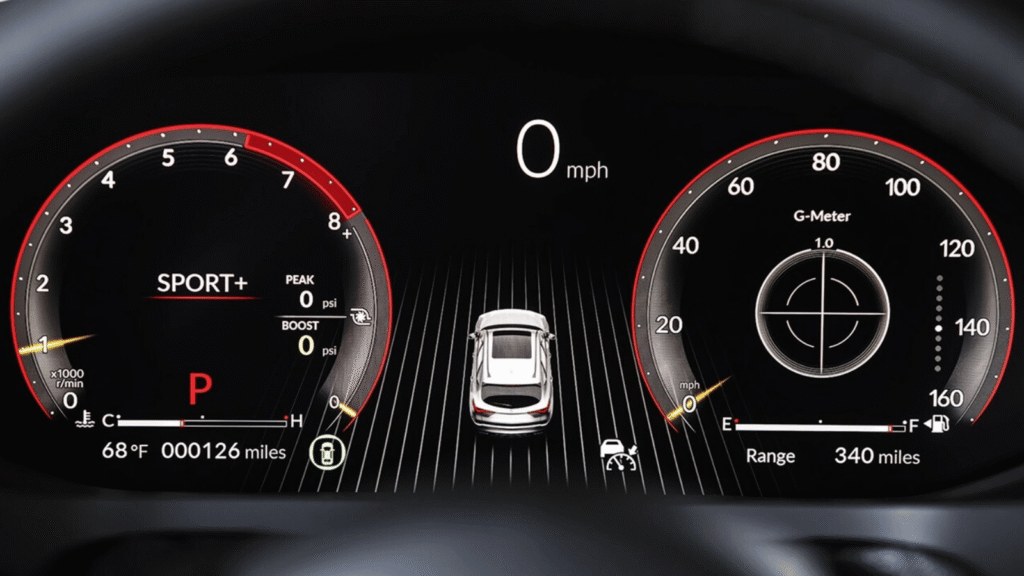
In 2026, AcuraWatch™ calibration is non-negotiable. The forward camera, mounted near the rearview mirror and calibrated to the windshield glass itself, loses alignment precision when the glass is replaced, when the A-pillar is repaired, or when the hood is removed during any front-end work. A qualified Acura body shop performs both static calibration — where targets are placed at precise distances in a controlled indoor environment — and dynamic calibration, which involves driving at specific speeds on open road while the system self-corrects against lane markings.
EV and Hybrid High-Voltage Platform Requirements
The Acura ZDX represents a new category of complexity for collision repair in the Los Angeles market. As an EV platform, it introduces high-voltage battery systems — operating at several hundred volts — that demand specific shop certifications, insulated tooling, and trained technicians authorized to work safely around energized components.
Even minor structural repairs in the rear section of a ZDX must account for the position of high-voltage cabling and battery enclosure geometry. Unauthorized repairs to EV and hybrid structural elements risk both technician safety and catastrophic battery damage that may not manifest immediately. Our facility is equipped and certified to handle Acura collision repair in Los Angeles on current and emerging electrified platforms.
Advanced Metallurgy and Ultra-High-Strength Steel
Modern Acura body structures use a strategic combination of materials: conventional mild steel, high-strength steel, ultra-high-strength steel (UHSS), and aluminum alloys — sometimes all within the same structural assembly. Tailored blanks — single pieces of steel with varying thickness and metallurgical properties rolled into a single component — require precise, certified welding procedures.
Applying heat incorrectly to UHSS sections, or using inappropriate welding wire, degrades the steel’s engineered strength properties and transforms a precision crumple zone into an unpredictable structural liability. Only a specialist Acura body shop with certified MIG brazing and resistance spot-welding equipment can repair these sections correctly.
Fascinating Engineering Fact: The latest generation of Acura’s ACE™ structure incorporates extra braces at the front corners specifically engineered to handle narrow-offset collisions — the scenario where only a small portion of the front end absorbs impact. This is the collision type most likely to send force directly toward the A-pillar and driver-side cabin, and the geometry of those braces must be exactly right after any repair.
The Truth About Parts: Genuine Acura OEM vs. Generic Aftermarket Components
One of the most consequential decisions made during any collision repair happens in a parts room or a computer ordering system — and most vehicle owners have no idea it’s being made on their behalf. The choice between Genuine Acura OEM parts and generic aftermarket alternatives is not a matter of brand loyalty. It is a matter of structural physics, safety system performance, and long-term vehicle value.
The average diminished value loss ranges from 10% to 25% of a car’s fair market value before the accident. For example, if your car was worth $30,000 before the crash, you could lose $3,000 to $7,500 in value — even after repairs.
Evaluation Metric | Genuine Acura OEM Parts | Generic Aftermarket Alternatives |
Structural Fit & Tolerances | Engineered to millimeter-precise factory blueprints for seamless body lines | Reverse-engineered; often suffers from gaps, warping, or forced fitment |
Crash Safety Performance | Designed to crumple predictably, working in concert with Acura’s ACE™ body structure | Unpredictable metallurgical properties; may compromise occupant cabin safety in a secondary crash |
AcuraWatch™ Compatibility | Guaranteed radar transparency and optimal sensor bracket alignment | Can distort sensor signals, triggering dashboard faults or system failures |
Vehicle Resale Value Protection | Preserves original vehicle integrity and protects premium lease and trade-in value | Frequently triggers appraisal deductions due to non-standard parts detection |
Warranty Assurance | Backed by manufacturer performance standards; will not void existing factory vehicle warranties | Offers limited third-party warranties that leave your vehicle unprotected by Acura |
Worth Knowing: ADAS-equipped vehicles face a specific compounding problem with aftermarket parts: aftermarket panels and bumpers can alter the mounting geometry of sensors, meaning a car that looks repaired may be running calibration errors that neither the driver nor a casual buyer would detect.
At Metro Collision Center, we default to Genuine Acura OEM parts on every repair — and we document their use in your repair records. If an insurer attempts to substitute aftermarket components, our team advocates on your behalf, citing the technical and legal basis for OEM specifications. You have the right to OEM parts when appropriate, and we exercise that right for you.
Acura Aesthetic Care: Style and Protection Tips for the LA Environment
Los Angeles is one of the most demanding environments on earth for automotive finishes. Intense UV radiation, Pacific marine air carrying salt and fine particulate matter, urban smog, and the daily gauntlet of parking structures and crowded surface streets all conspire against your vehicle’s exterior. Here is how to protect your Acura’s distinctive appearance:
1. Multi-Stage Paint Protection Against LA's UV Environment
Acura’s signature deep finishes — Apex Blue Pearl, Performance Red Pearl, Liquid Carbon Metallic — derive their depth from multiple layers of basecoat and effect pigments beneath a clear topcoat. UV degradation attacks the clear coat first, producing a chalky, oxidized film that destroys the depth that makes these colors spectacular. A professionally applied ceramic coating creates a sacrificial UV barrier several times harder than standard clear coat, preserving color depth for years. Following any collision repair, apply ceramic protection to the newly painted panels to restore full UV defense.
LA-Specific Fact: The Los Angeles Basin receives an average of 284 sunny days per year — one of the highest UV exposure rates of any major American city. That sustained radiation is the single greatest long-term threat to an Acura’s multi-stage factory finish, making paint protection here far more than a cosmetic luxury.
2. Paintless Dent Repair for Preserving Factory Finishes
The parking structures on Wilshire, Rodeo Drive, and throughout Hollywood are merciless on lower door panels and rear quarter panels. For minor door dings and hail impressions that haven’t broken through the paint surface, Paintless Dent Repair (PDR) offers a solution that preserves the factory e-coat and original paint layers entirely. Using precision lighting and specialized steel rods, a trained PDR technician massages the metal back to its original contour without a single drop of filler or paint. The result is indistinguishable from the factory panel — because it is the factory panel, unchanged.
3. Precision Wheel and Trim Restoration
Acura’s A-Spec and Type S models feature machined-finish alloy wheels — a process that creates a two-tone appearance by machine-cutting the face of a painted or anodized wheel to expose bright aluminum beneath. These wheels are particularly vulnerable to curb rash and require a specialist restoration process that recuts the face on a CNC lathe after refinishing. Standard wheel repair methods that simply grind and repaint destroy the machined finish permanently. Similarly, the dark chrome and gloss-black trim accents characteristic of current Acura exterior packages require specific refinishing procedures to maintain their contrast and depth against the body color.
Navigating the Aftermath: 5 Vital Steps to Take Right After an LA Car Accident
The period immediately following a collision is disorienting. Adrenaline interferes with clear thinking, and the decisions made in those first hours have lasting consequences for your safety, your legal standing, and your vehicle’s repair outcome. Follow these steps precisely:
Step 1: Ensure Safety and Summon Emergency Services
If your vehicle is drivable and no injuries are evident, move it to the nearest safe location out of active traffic — ideally a parking lot or wide shoulder. Activate hazard lights. If there is any possibility of injury, call 911 immediately. Do not move an injured occupant unless the vehicle presents an immediate fire or environmental hazard. In California, a police report is legally required for any collision involving injury, death, or property damage exceeding $1,000 — which in Los Angeles effectively means every collision.
Step 2: Document Everything Before Moving On
Use your phone to photograph every vehicle involved from multiple angles, capturing license plates, VIN stickers visible through the windshield, the positions of all vehicles relative to intersection markings or road features, any visible damage on all vehicles, and the overall scene from a wide angle. Photograph any skid marks, debris fields, or traffic control devices relevant to how the collision occurred. Exchange insurance cards, driver's license information, and contact information with all parties — but limit conversation to factual information only.
Step 3: Notify Your Insurer — But Know Your Rights First
Report the collision to your insurance carrier as required by your policy, but understand California Insurance Code § 758.5 before you do: you have the absolute legal right to choose your own repair facility regardless of any insurer "preferred network" or "direct repair program." Insurers may suggest specific shops — you are under no obligation to use them. Choose the facility qualified to properly repair your specific vehicle.
Step 4: Avoid Driving a Potentially Compromised Vehicle
If your Acura deployed its airbags, if the steering pulls noticeably, if warning lights have illuminated, or if visible structural damage is present, have the vehicle transported rather than driven. AcuraWatch™ systems that have been disrupted by a collision may respond unpredictably while driving, and structural damage can affect handling geometry in ways that are not immediately obvious but are genuinely dangerous.
Critical Safety Note: Almost 70% of all repairable appraisals now include a diagnostic scan — because fault codes triggered by a collision frequently do not surface as warning lights until the vehicle is driven. A car that looks and drives “fine” immediately after a crash may still be running corrupted safety system data.
Step 5: Contact Metro Collision Center Directly
Call Metro Collision Center before committing to any repair authorization with your insurer. Our team will walk you through the documentation we need, explain the blueprinting process, and begin coordinating with your insurance carrier on your behalf. We handle the technical advocacy so that the correct repair methodology — OEM parts, factory-procedure structural repair, full ADAS calibration — is approved and documented from the outset. For Acura collision repair in Los Angeles, this is the call that protects your investment from the moment it happens.
Our technicians hold I-CAR Gold Class certification — the highest professional recognition in the collision repair industry. I-CAR Gold Class means our team completes ongoing, role-specific training every single year to stay current with the latest repair technologies, materials, and procedures. For a Acura owner in 2026, that matters more than ever. These cars are genuinely complex, and you want certified hands working on yours.
Here’s what our process looks like from your side:
- 📞 Call or submit a free estimate online — we respond fast, usually same day
- 🔍 Drop it off — we scan, assess, and handle all insurance communication
- 🔧 We repair it right and paint it perfectly— OEM parts, proper procedures, full ADAS calibration
- 🚗 You pick it up — looking exactly like the accident never happened
Quick. Painless. Done right the first time.
👉 Request your free estimate at metrocollisionla.com or give us a call. We’ll take it from here.
Metro Collision Center | Serving Acura drivers across the greater Los Angeles metropolitan area. Lifetime craftsmanship guarantee on all collision repairs.
Frequently Asked Questions: Authoritative Insights on Acura Collision Repair
Does an Acura body shop always use original factory parts?
A specialized Acura body shop like Metro Collision Center prioritizes Original Equipment Manufacturer (OEM) parts because they are built to exact factory blueprints, guaranteeing optimal structural alignment, proper crumple-zone performance, and the preservation of your vehicle’s factory warranty. While some insurers push for aftermarket alternatives to reduce claim costs, a qualified Acura body shop advocates for OEM components based on the technical and safety basis for their use — and documents all parts used in your repair records.
How much does auto body repair cost for an Acura in Los Angeles?
The cost of Acura collision repair varies significantly based on severity. Minor cosmetic bumper scrapes typically range from $600 to $1,500, whereas major structural collision repairs involving AcuraWatch™ sensor replacement and multi-stage paint matching can exceed $5,000 to $10,000. Repairs involving EV battery system proximity, structural realignment, and extensive parts procurement will fall toward the higher end of that range. A transparent blueprinting estimate at Metro Collision Center provides a complete, itemized breakdown before any work begins.
Am I required to use the collision repair facility my insurance provider recommends?
No. Under California Insurance Code § 758.5, you possess the absolute legal right to select any auto body shop for your vehicle repairs. This allows you to bypass generalized insurer networks in favor of specialized facilities like Metro Collision Center that have the specific equipment, training, and parts access required for proper Acura collision repair in Los Angeles.
How long will it take to complete Acura collision repair in Los Angeles?
Cosmetic repairs or minor panel replacements generally require 3 to 7 business days. Major structural remediation requiring specialized frame alignment, factory parts sourcing, and comprehensive electronic calibrations can take between 2 to 4 weeks. EV platform repairs involving high-voltage system proximity may extend timelines further depending on parts availability. Your assigned advisor at our Acura body shop provides timeline updates throughout the repair process.
Why does my Acura require camera and radar calibration after a body repair?
Acura vehicles feature advanced driver-assistance technology called AcuraWatch™. Any physical impact or panel removal alters the exact alignment of these forward-facing cameras and radar sensors, demanding computerized recalibration to prevent critical safety system failures. This is true even for apparently minor repairs — replacing a windshield, repairing a front bumper cover, or removing a hood panel can shift sensor alignment enough to compromise emergency braking accuracy.
Can an auto body shop perfectly match Acura's multi-stage paint colors?
Yes. Professional collision facilities utilize computerized spectrophotometer color-matching alongside high-end waterborne paint lines to accurately replicate and seamlessly blend Acura’s complex multi-stage finishes, such as Majestic Black or Apex Blue Pearl. Our Acura body shop uses spectrophotometric analysis on your specific vehicle’s painted surfaces — accounting for weathering, UV exposure, and factory application variation — to achieve a blend that is visually indistinguishable from the surrounding original paint.
What happens to my vehicle's resale value if I don't use a specialized Acura repair center?
Failing to use a specialized shop often results in mismatched body panels, compromised safety systems, and the use of aftermarket parts — all of which are flagged during vehicle inspections and cause significant diminished value. Carfax and vehicle history services now track insurance claims, and appraisers who inspect vehicles at trade-in or auction can identify non-OEM repairs through paint thickness measurements and panel fit analysis. The cost savings of a discount repair often exceed the resulting depreciation penalty by a substantial margin.
Will Metro Collision Center coordinate directly with my auto insurance company?
Yes. Metro Collision Center manages the entire claims workflow by interfacing directly with all major auto insurance carriers — submitting digital blueprints, negotiating repair supplements, and securing authorization for correct repair methodologies without stress to the vehicle owner. Our insurance team has established relationships with adjusters at the major carriers serving the Los Angeles market and understands the documentation language and supplement process required to protect your vehicle’s repair quality.