Let’s be real — getting into an accident is one of the most stressful things that can happen to you as a car owner. One minute you’re cruising down the 101, and the next you’re standing on the shoulder staring at a crumpled bumper, your heart doing things it really shouldn’t. If your Honda just took a hit, the last thing you want to do is hand it off to just any shop and hope for the best.
Your Honda isn’t just a car. It’s an engineering achievement built to very specific safety standards, and fixing it right means finding a Honda body shop that actually understands that. In Los Angeles, that shop is Metro Collision Center — and this guide is going to tell you exactly why.
Why You Need a Specialized Honda Body Shop After an Accident
Here’s something most people don’t know: not all collision repair shops are equipped to work on Hondas properly. That might sound like a sales pitch, but stick with us — there’s real engineering behind this.
Honda vehicles are built with Advanced Compatibility Engineering (ACE™) body structures, a proprietary crumple zone system designed to distribute crash energy away from the cabin and protect occupants. If a technician who doesn’t understand this system starts welding, cutting, or reshaping panels without following Honda’s exact repair procedures, they can actually compromise the structural integrity of that safety system. Your car might look fine when it rolls out of the shop, but in a second collision, it won’t perform the way Honda engineered it to.
Then there’s Honda Sensing® — the suite of safety technologies built into most modern Hondas that includes collision mitigation braking, road departure mitigation, lane keeping assist, and adaptive cruise control. These systems rely on a network of cameras, radar units, and sensors mounted throughout the vehicle. A fender bender that shifts a front camera even a fraction of a degree can cause your lane-keeping system to behave erratically, or worse — fail to trigger automatic braking when you need it most.
A specialized Honda body shop knows all of this. The technicians are trained specifically on Honda repair protocols, they have access to Honda’s proprietary repair documentation, and they know which components require replacement versus recalibration. This isn’t just about cosmetics. It’s about making sure your car is safe to drive after it leaves the shop.
At Metro Collision Center, our technicians don’t guess. Every Honda repair follows manufacturer-approved procedures from start to finish, because your family is in that car, and that matters more than anything else.
Can You Choose Your Own Honda Body Shop in Los Angeles After an Insurance Claim?
Short answer? Yes. Absolutely yes.
And yet, somehow, this is one of the most misunderstood things about the entire insurance claims process. A lot of drivers assume that when their insurer hands them a list of “preferred” or “approved” shops, that’s the list they have to use. No exceptions, no questions asked.
That’s not how it works. Not in California, anyway.
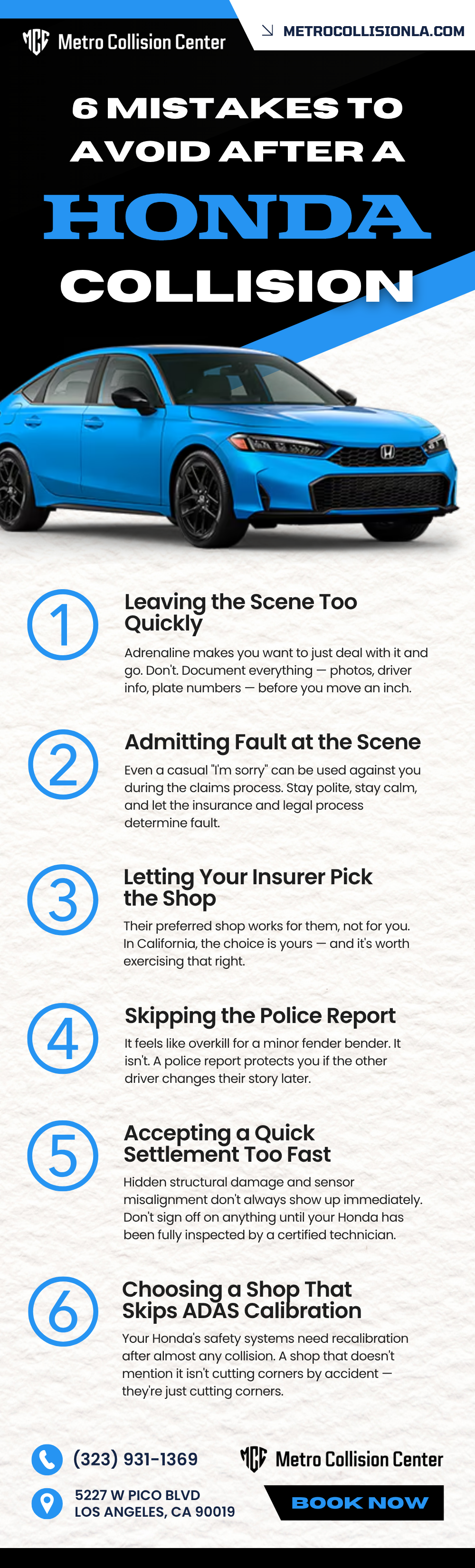
California law explicitly gives you the right to choose any licensed auto body shop for your repairs — regardless of what your insurance company recommends. Your insurer can suggest shops until they’re blue in the face, but they cannot legally force you into one. If anyone implies otherwise, that’s worth pushing back on.
So why do insurance companies push their preferred shops so hard? Simple. Those shops have negotiated pricing agreements with the insurer that help keep claim costs down. That’s great for the insurance company’s bottom line. It’s not always great for your Honda.
Preferred shops sometimes cut costs by using aftermarket parts instead of OEM, moving faster than a thorough repair really allows, or skipping steps like ADAS calibration that add time but are absolutely critical for your safety.
Here’s what you should do instead. When your insurer asks which shop you’d like to use, you tell them: Metro Collision Center. Done. They’re required to work with your chosen shop — that’s the law. Our team handles the communication, the back-and-forth, and the advocacy for proper OEM parts directly with your insurer, so you don’t have to navigate any of that yourself.
Your car, your choice. Always.
The Metro Collision Difference: Your Trusted Honda Body Shop in Los Angeles
So what makes a Honda body shop in Los Angeles worth trusting? A few things: transparency, technology, and people who actually care about doing the job right.
Metro Collision Center checks every one of those boxes.
Walk into our facility and you’ll notice it immediately — this isn’t your uncle’s garage. Our shop is equipped with state-of-the-art frame straightening equipment, computerized color-matching systems, and a dedicated ADAS calibration bay. We handle everything from minor door dings to major structural repairs, and we do it with the kind of precision that Honda’s engineering demands.
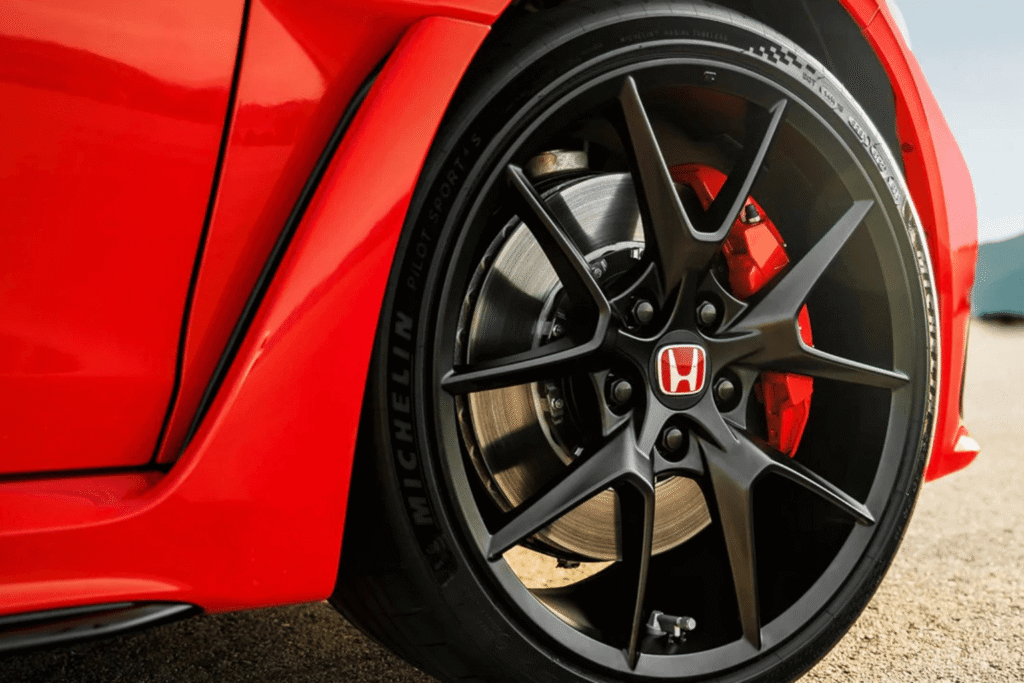
Here’s what sets us apart:
- Lifetime Guarantee on Repairs: We stand behind our work — not just for a few months, but for as long as you own the vehicle. That’s how confident we are in our quality.
- Full Transparency: You’ll receive a detailed written estimate before any work begins. No surprises. No hidden fees. No “we found something else” calls that make your stomach drop.
- Direct Insurance Coordination: We work directly with all major insurance providers so you don’t have to play middleman between your insurer and the repair shop. We handle the back-and-forth, advocate for OEM parts, and make sure your claim is handled fairly.
- Certified Technicians: Our team includes I-CAR Gold Class certified professionals who are continuously trained on the latest Honda repair standards.
- Eco-Friendly Waterborne Paint: Our paint system uses advanced waterborne technology that meets strict LA environmental regulations while delivering a factory-perfect color match.
When you bring your Honda to Metro Collision Center — your Honda body shop in Los Angeles — you’re not just getting a repair. You’re getting peace of mind.
2026 Collision Repair Trends: How Honda Safety Systems Are Evolving
The auto body repair industry is changing fast, and if you’re picking a Honda body shop in Los Angeles, you want one that’s keeping up. Here’s what’s shaping collision repair in 2026 and why it matters for your Honda specifically.
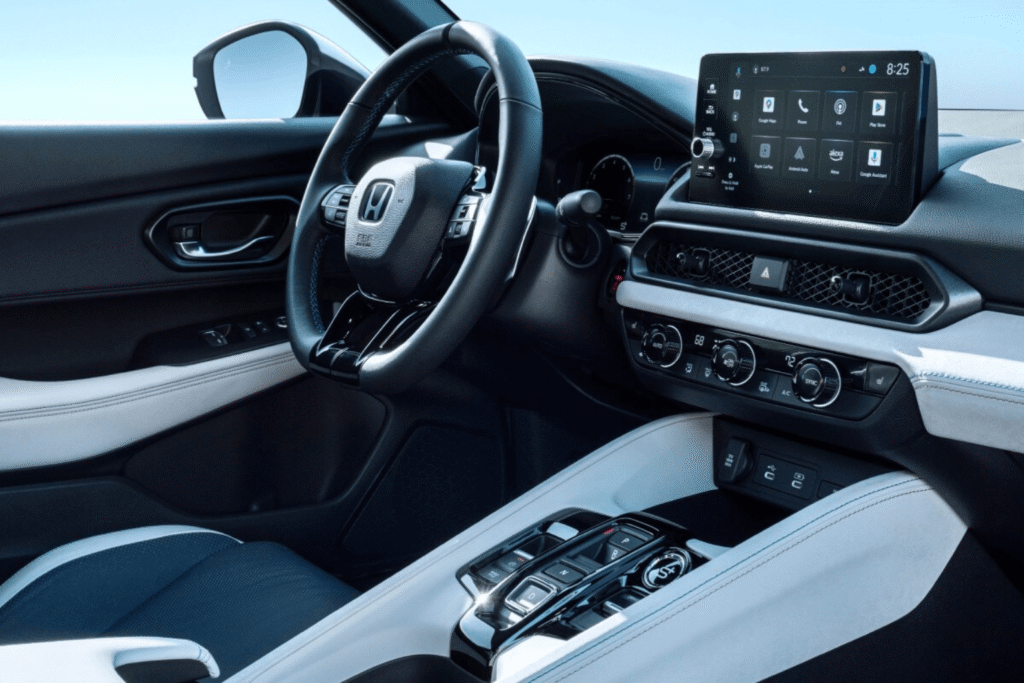
Mandatory ADAS Calibration — Even for Minor Bumps
This is the big one. In 2026, ADAS (Advanced Driver Assistance Systems) calibration has become a non-negotiable part of almost every collision repair — including minor ones. Got a small bumper tap in a parking lot? That’s potentially enough to shift the radar sensor that controls your Honda’s automatic emergency braking.
Modern Hondas are essentially rolling computers. The Honda Sensing® suite uses a forward-facing camera and radar mounted near the windshield and grille — two of the most vulnerable spots in a frontal collision. If those components shift even slightly, your safety systems won’t work the way they’re supposed to. At Metro Collision Center, every repair involving a potential sensor disruption is followed by a full ADAS calibration using Honda-approved equipment. We verify that every system is functioning within factory spec before your car leaves our lot.
EV and Hybrid Structural Safety
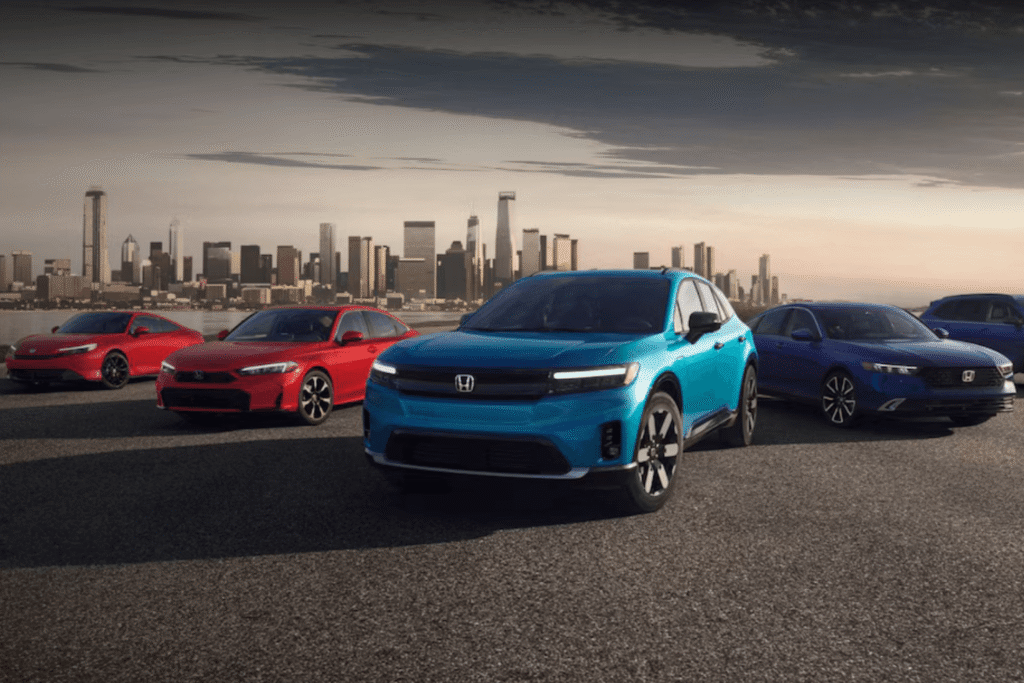
Honda’s lineup is going electric, and that changes things significantly for collision repair. The CR-V Hybrid, the Accord Hybrid, and the Honda Prologue EV all carry high-voltage battery systems — some operating at 400 volts or higher. Repairing these vehicles requires technicians trained specifically in high-voltage safety protocols. One misstep in a hybrid or EV repair isn’t just a bad paint job — it’s a potential electrical hazard.
Metro Collision Center’s technicians are trained and certified for hybrid and EV repairs, following strict Honda guidelines for handling, isolating, and reinstalling high-voltage components. Your Honda Prologue or CR-V Hybrid is safe in our hands.
Eco-Friendly Waterborne Paint Technology
LA has some of the strictest air quality regulations in the country — and for good reason. Traditional solvent-based auto paint is loaded with volatile organic compounds (VOCs) that contribute to smog. In 2026, the best Honda body shops in Los Angeles have fully transitioned to waterborne paint systems that dramatically reduce VOC emissions while delivering superior color accuracy.
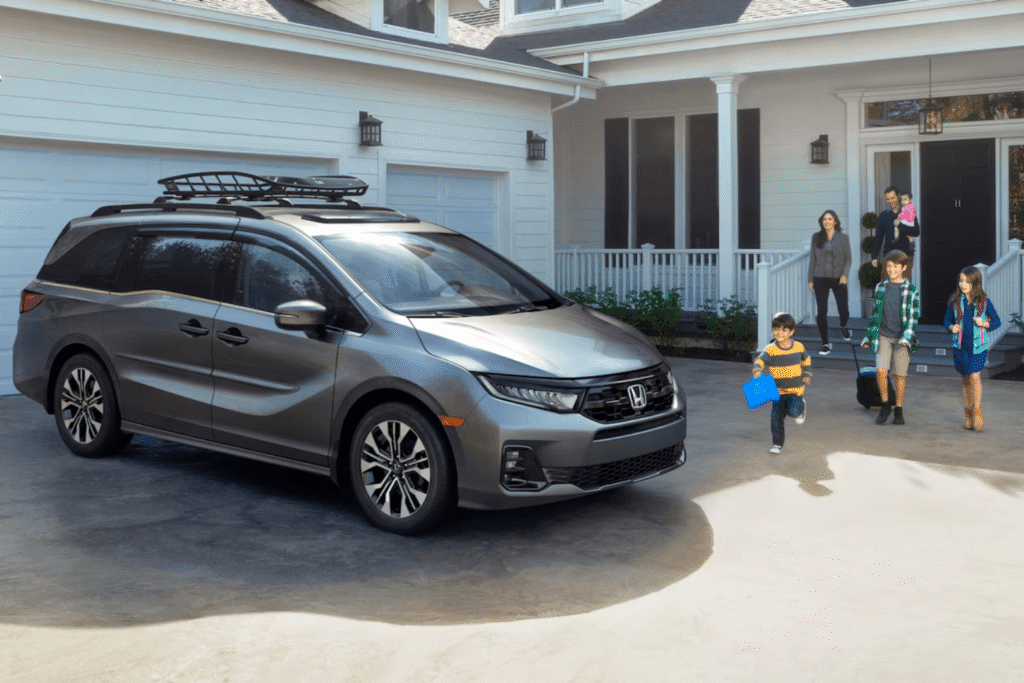
At Metro Collision Center, we use advanced waterborne paint technology that is both environmentally responsible and incredibly precise. Our computerized color-matching system reads your Honda’s factory paint code and accounts for natural fading and weathering, so the new paint blends seamlessly with your existing finish. You won’t be able to tell where the repair ends and the original paint begins — and that’s exactly the point.
OEM vs. Aftermarket Parts: What Your Insurance Company Isn't Telling You
Let’s have an honest conversation about parts. When your insurance company sends you to their “preferred” shop, there’s a reason they have a preference — and it usually comes down to cost savings for them, not quality for you.
Many insurance-preferred shops default to aftermarket parts — components manufactured by third-party companies, not Honda. Here’s what that looks like in practice:
|
Factor |
OEM Honda Parts |
Aftermarket Parts |
|
Fit & Finish |
Exact factory fit, every time |
May require modification; gaps and misalignment are common |
|
Safety Performance |
Engineered and crash-tested by Honda for your specific model |
Not crash-tested to Honda’s standards; structural integrity may vary |
|
Resale Value |
Preserves vehicle value; buyers and appraisers can verify OEM restoration |
Can lower resale value; may flag on vehicle history reports |
|
Warranty |
Covered under Honda’s parts warranty |
Warranty varies; often limited or difficult to claim |
|
Paint Match |
Factory-matched primer and surface prep |
May require additional prep; color matching can be inconsistent |
|
Long-Term Durability |
Designed to Honda’s lifespan specifications |
Quality inconsistency between manufacturers |
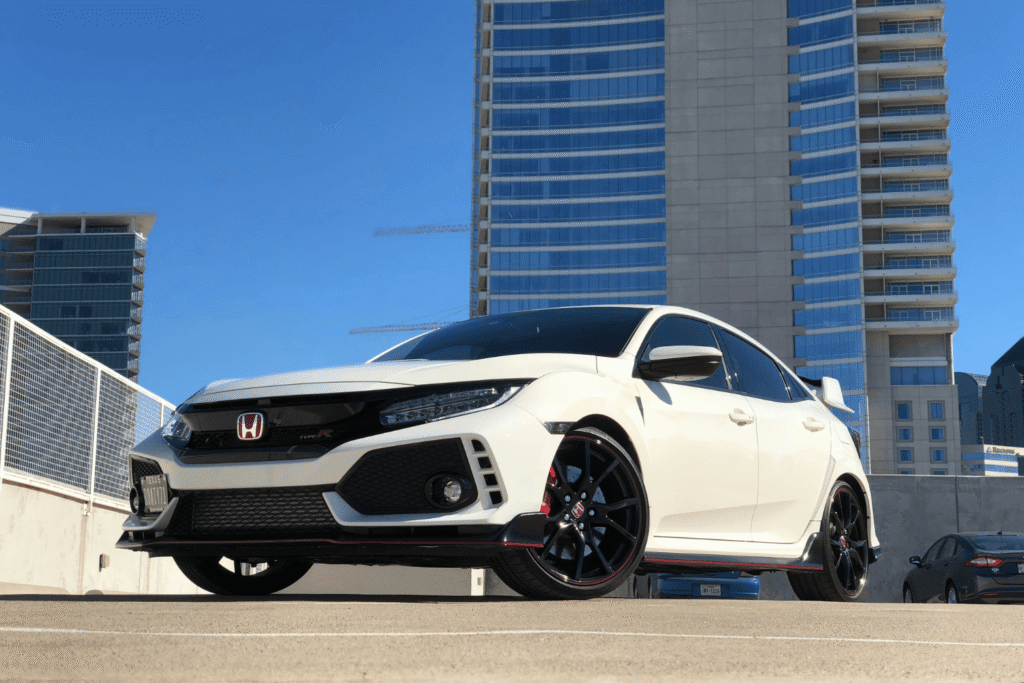
Here’s the thing — California law gives you the right to request OEM parts for your repair. Your insurance company may try to push back, but you are entitled to insist on it, especially for safety-critical components like bumper reinforcement bars, airbag components, and structural panels.
At Metro Collision Center, we advocate for OEM parts on every Honda repair we handle. We’ll negotiate directly with your insurer, document the necessity of OEM parts where applicable, and make sure your Honda is restored the way Honda built it — not the way a budget insurer wants it rebuilt.
Honda Aesthetic & "Style" Tips: Keeping Your Car Showroom-New in LA
Getting your Honda repaired is the first step. Keeping it looking incredible afterward — especially in the brutal LA environment — is the second. Here’s how to protect that fresh paint and keep your Honda turning heads.
Ceramic Coating: Your Honda’s Best Friend in LA
Los Angeles is genuinely tough on paint. UV radiation, smog, bird droppings, and the occasional carwash that’s more aggressive than it should be — all of these things degrade your clear coat over time. Applying a professional ceramic coating after your collision repair creates a semi-permanent hydrophobic layer that repels contaminants, blocks UV rays, and makes your Honda dramatically easier to clean. Ask Metro Collision Center about ceramic coating add-ons when you pick up your repaired vehicle.
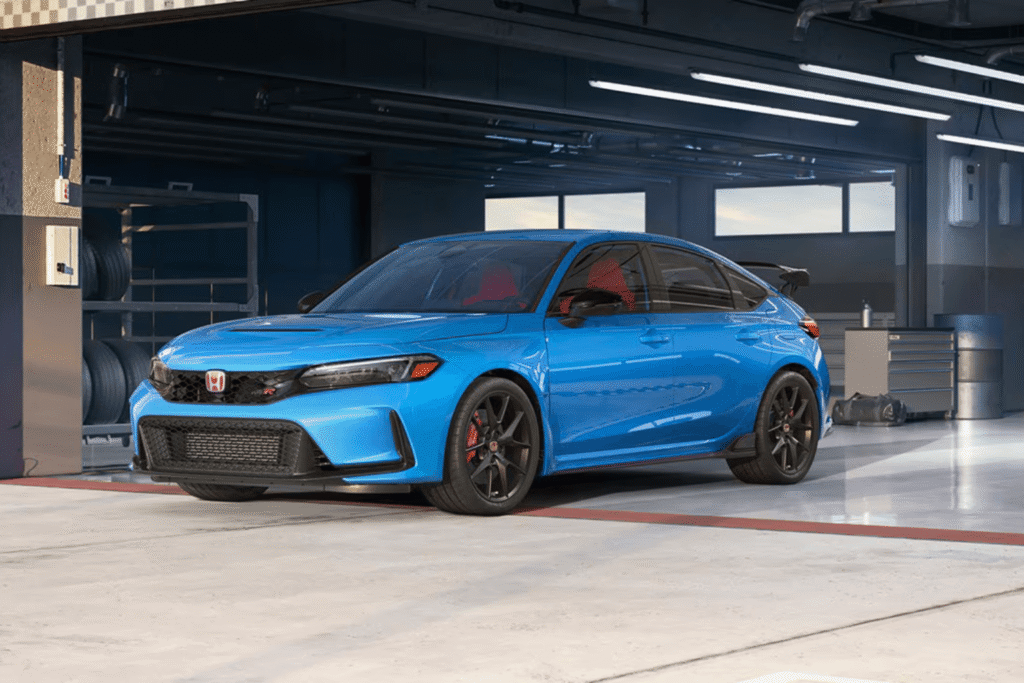
Paintless Dent Repair (PDR): The Stealth Fix
LA parking structures are basically obstacle courses, and door dings are an inevitability. The good news is that Paintless Dent Repair can fix minor dings and dents without touching the original factory paint. A dent repair and removal technician uses specialized tools to gently massage the metal back into shape from behind the panel. It’s faster, cheaper, and — crucially — it doesn’t disturb the original factory finish, which means no risk of paint color mismatch. If your Honda has minor dings, PDR is almost always the right call.
Wheel Restoration: Don’t Ignore the Rims
Curbed or scuffed alloy wheels are incredibly common in LA, and they drag down the entire look of an otherwise clean Honda. Wheel repair and refinish — which involves sanding, priming, and refinishing the alloy surface — can bring your rims back to like-new condition for a fraction of the cost of replacement. At Metro Collision Center, we can handle wheel restoration alongside your collision repair so your whole car comes out looking its best.
5 Crucial Steps to Take Immediately After an Accident in LA
Okay, you’ve just been in an accident. Your heart is racing, your hands might be shaking a little, and you have no idea what to do first. Here’s exactly what you should do, step by step:
Step 1: Make Sure Everyone Is Safe
Before anything else, check on yourself and any passengers. If anyone is injured, call 911 immediately. If the vehicles are drivable and it's safe to do so, move them to the shoulder or a nearby parking area to avoid blocking traffic.
Step 2: Call the Police and File a Report
In California, you're required to report any accident involving injury or significant property damage. Even if the other party seems cooperative, get a police report. It creates an official record that protects you during the insurance process.
Step 3: Document Everything
Use your phone to photograph every angle of both vehicles, the license plates, the surrounding area, road conditions, and any visible injuries. The more documentation you have, the stronger your position when dealing with insurance.
Step 4: Exchange Information — But Don't Admit Fault
Get the other driver's name, insurance information, license plate, and driver's license number. Be polite, but avoid saying anything that could be interpreted as admitting fault — even "I'm sorry" can be used against you.
Step 5: Contact Metro Collision Center Before You Call Your Insurance
Seriously — call us first. Our team can walk you through the claims process, advise you on your rights as a California driver, and make sure you're not talked into a low-ball settlement or steered toward an inferior shop. As a trusted Honda body shop in Los Angeles, we've helped thousands of Honda drivers navigate this exact situation. We'll take it from here.
What Happens After a Honda Accident: The Step-by-Step Repair Process at Metro Collision Center
Most people drop their car off at a Honda body shop and genuinely have no idea what happens next. It just… disappears into the garage, and a few days later someone hands you the keys. Magic, right?
Not exactly. There’s actually a very specific, very deliberate process happening behind those shop doors — and understanding it will make you a much more confident customer. So let’s walk through it, start to finish.
Step 1: The Initial Estimate (aka “How Bad Is It?”)
The moment your Honda arrives at our Honda body shop in Los Angeles, a collision repair specialist does a full visual assessment of the damage. This isn’t just a quick once-over — we’re looking at panel damage, frame alignment, glass integrity, and anything that might hint at deeper structural issues hiding beneath the surface.
You’ll receive a detailed written estimate that breaks down labor costs, parts, and projected timeline. No vague numbers. No “we’ll figure it out as we go.” Just a clear picture of what your repair involves and what it’s going to cost.
Pro tip: this is also the stage where Metro Collision contacts your insurance company on your behalf to open the claim and get the process moving. You’ve got enough on your plate.
Step 2: Teardown — The Real Damage Reveal
Here’s something that surprises a lot of people. What you see after an accident is rarely the whole story.
Once your Honda is checked in, our technicians begin a full teardown of the damaged area — removing panels, bumpers, trim pieces, and any components obstructing the repair zone. This is where the hidden damage shows up: bent brackets that weren’t visible from the outside, cracked mounting points, compromised structural supports, sensor housings that took a hit you didn’t even know about.
Think of it like peeling back the layers of an onion. Except less crying. Usually.
This teardown report gets documented with photos and sent directly to your insurance adjuster, which brings us to the next step.
Step 3: Insurance Approval
Nobody’s favorite part of the process — but it doesn’t have to be a nightmare.
Once the full scope of damage is documented, Metro Collision submits a comprehensive repair plan to your insurer. We advocate for OEM Honda parts at every stage, and if your insurance tries to substitute cheaper aftermarket components, we push back. That’s our job, and we take it seriously.
Approval timelines vary depending on your insurer, but our team actively follows up so your Honda isn’t just sitting there collecting dust while paperwork shuffles around. Most approvals come through within one to two business days. Then the real work begins.
Step 4: Structural and Frame Repair
If your Honda took a significant hit, there’s a good chance the frame or unibody structure needs attention. This is the most critical stage of the entire repair — and it’s where choosing the right Honda body shop makes the biggest difference.
We use computerized frame measuring systems that map your Honda’s structural geometry down to the millimeter, comparing it against Honda’s factory specifications. Any deviation — no matter how small — gets corrected using precision hydraulic straightening equipment.
Why does this matter so much? Because Honda’s ACE™ body structure is engineered to behave a very specific way in a collision. If the frame isn’t back to exact factory spec, that safety engineering is compromised. A car that looks straight on the outside can still be structurally wrong. We make sure it isn’t.

Step 5: Parts Replacement
With the structure sorted, it’s time to replace everything that couldn’t be repaired — panels, bumper components, brackets, sensors, lights, you name it.
At Metro Collision Center, we use OEM Honda parts as standard. That means every replacement component was made by Honda, engineered to Honda’s exact tolerances, and designed to fit your specific model and trim without modification. No trimming, no bending, no “close enough.”
This matters enormously for both safety and resale value. Insurance adjusters and used car buyers alike can tell the difference between a proper OEM repair and a patchwork of aftermarket parts.
Step 6: Paint — Where Science Meets Art
This is the stage that makes or breaks a repair visually. And honestly, it’s where a lot of lesser shops fall short.
Our Honda body shop uses computerized spectrophotometer color-matching technology that reads your Honda’s exact paint code and cross-references it with real-world factors like age, sun exposure, and surface variation. Because a brand-new color mixed straight from the code won’t necessarily match a three-year-old finish that’s been sitting in the California sun — and our technicians know that.
Once the color is dialed in, we apply eco-friendly waterborne paint in our climate-controlled spray booth, building up layers of primer, base coat, and clear coat exactly the way Honda does at the factory. Adjacent panels get a careful blend so the repair fades seamlessly into the original paint. When it’s done right, you genuinely cannot tell where the repair begins and ends.
That’s the goal. That’s the standard.
Step 7: ADAS Calibration — The Step Most Shops Skip
Here’s where things get very 2026. And here’s where a lot of Honda body shops in Los Angeles drop the ball entirely.
Modern Hondas are loaded with cameras, radar units, and sensors that power Honda Sensing® features — automatic emergency braking, lane-keeping assist, adaptive cruise control. These systems are calibrated to work within incredibly tight tolerances. A front-end repair that shifts a radar sensor by a few millimeters? That’s enough to make your collision mitigation system unreliable.
After every repair involving front-end, rear, or suspension work, our technicians perform a full ADAS calibration using Honda-approved diagnostic equipment. We verify that every sensor is aligned, every camera is reading correctly, and every safety feature is functioning exactly as Honda intended.
This step isn’t optional. It isn’t a nice-to-have. It’s the difference between a car that’s safe to drive and one that merely looks safe.
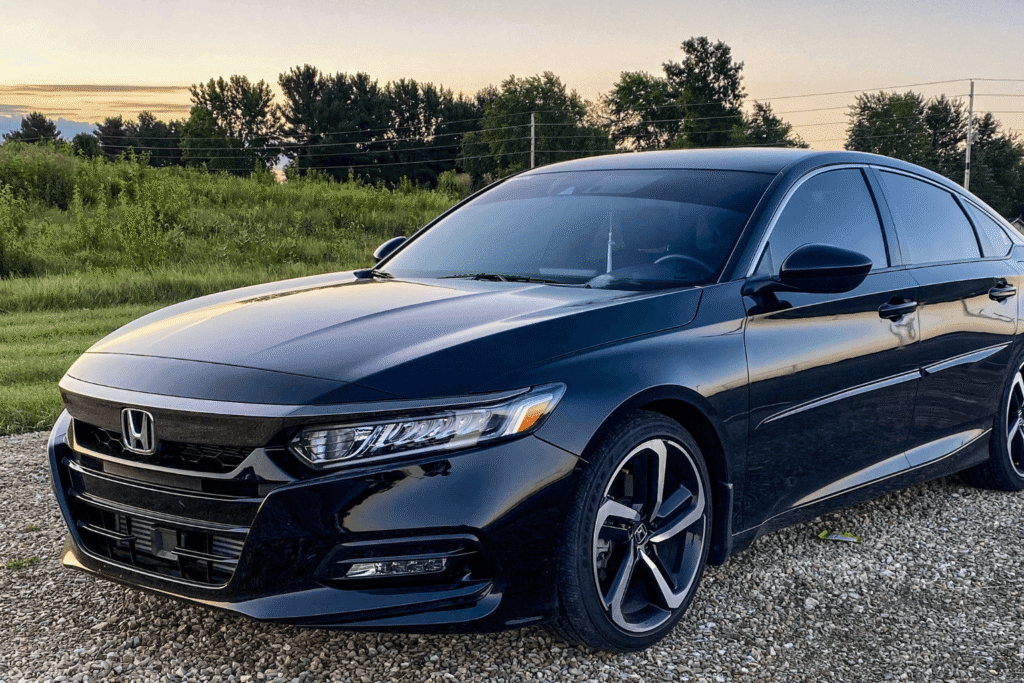
Step 8: Quality Control Inspection
Before your Honda even thinks about leaving our shop, it goes through a multi-point quality control inspection conducted by a senior technician who had no involvement in the repair itself. Fresh eyes, full checklist.
We’re checking panel gaps and alignment, paint finish consistency, structural integrity, all replaced parts, electrical systems, and the results of every ADAS calibration test. If anything doesn’t meet Metro Collision’s standards — or Honda’s factory standards — it goes back. Full stop.
This is the step that earns us the ability to offer a lifetime guarantee on our repairs. We don’t skip it. Ever.
Step 9: Delivery — Your Honda, Better Than You Left It
This is the best part of the whole process — and we genuinely love this moment.
When you come to pick up your Honda, we don’t just hand you the keys and point at the door. We walk you through the repair, show you exactly what was done, and explain the calibration results so you know your safety systems are fully operational. We review the warranty, answer every question, and make sure you leave with total confidence in your vehicle.
Your Honda went through something. So did you. Our job is to make sure both of you come out the other side in better shape than you went in.
The whole process — from estimate to delivery — is designed around one idea: getting your Honda back to factory standards, not just factory appearance. That’s what separates a real Honda body shop in Los Angeles from a shop that just makes things look okay. And that’s the Metro Collision difference.
Your Honda Deserves Better Than "Good Enough"
At the end of the day, choosing a Honda body shop is about more than fixing what’s broken. It’s about restoring your car to the safety standard it was built to — and giving yourself one less thing to worry about during an already stressful time.
Metro Collision Center is the Honda body shop in Los Angeles that drivers trust when it matters most. From OEM parts and ADAS calibration to full insurance coordination and a lifetime repair guarantee, we’ve built our reputation one flawlessly restored Honda at a time.
Our technicians hold I-CAR Gold Class certification — the highest professional recognition in the collision repair industry. I-CAR Gold Class means our team completes ongoing, role-specific training every single year to stay current with the latest repair technologies, materials, and procedures. For a Honda owner in 2026, that matters more than ever. These cars are genuinely complex, and you want certified hands working on yours.
Here’s what our process looks like from your side:
- 📞 Call or submit a free estimate online — we respond fast, usually same day
- 🔍 Drop it off — we scan, assess, and handle all insurance communication
- 🔧 We repair it right and paint it perfectly— OEM parts, proper procedures, full ADAS calibration
- 🚗 You pick it up — looking exactly like the accident never happened
Quick. Painless. Done right the first time.
👉 Request your free estimate at metrocollisionla.com or give us a call. We’ll take it from here.
Metro Collision Center | Los Angeles, CA | Specializing in Honda Body Shop Repair & OEM Structural Repair
Frequently Asked Questions
Does a Honda body shop use OEM parts?
Yes, a reputable Honda body shop uses Original Equipment Manufacturer (OEM) parts to ensure an exact fit, optimal safety in future collisions, and the preservation of the vehicle’s factory warranty.
How much does auto body repair cost for a Honda?
Auto body repair for a Honda typically costs between $500 for minor bumper scrapes to over $5,000 for major collision damage, depending on local labor rates and the specific parts required.
Do I have to use the body shop my insurance company recommends?
No, by California law, you have the absolute right to choose any auto body shop for your repairs, including specialized facilities like Metro Collision Center in Los Angeles.
How long does collision repair take at a Honda body shop in Los Angeles?
Minor collision repairs typically take 3 to 5 days, while major structural or frame repairs can take 2 to 4 weeks depending on the availability of specialized Honda parts and insurance approval times.
What is ADAS calibration in auto body repair?
ADAS (Advanced Driver Assistance Systems) calibration is the precise alignment of a vehicle’s cameras, radars, and sensors after a collision to ensure safety features like lane-keeping assist and automatic emergency braking function correctly.
Will my Honda's paint match perfectly after an accident?
Yes, certified collision centers use computerized color-matching technology and seamlessly blend the new waterborne paint into adjacent panels to guarantee a perfect, factory-finish match.
What is the difference between OEM and aftermarket Honda parts?
OEM parts are made by Honda to exact factory specifications for perfect fit and structural integrity, whereas aftermarket parts are produced by third-party companies and may vary significantly in quality, fitment, and crash performance.
Does Metro Collision Center handle insurance claims for me?
Yes, Metro Collision Center works directly with all major insurance companies to process claims, negotiate repair costs, and ensure your Honda is repaired correctly without hidden out-of-pocket surprises.